If you’ve ever watched a steel water jet tear through a concrete slab, or handled a ceramic coffee mug that’s survived three years of daily dishwasher cycles, you’ve seen abrasion resistance at work. As a ceramic parts supplier, I get asked this question a lot: What makes ceramic parts so good at resisting wear, and how does that translate to real-world performance for our customers? The answer isn’t just “ceramics are hard”—it’s a mix of material science, manufacturing precision, and tailored properties that make our parts stand up to the most punishing industrial environments. Ceramic Parts
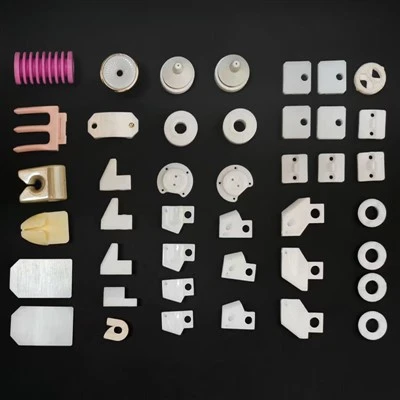
Let’s start with the basics: abrasion is defined as the process of wear through friction, scraping, or impact between two surfaces. For industrial parts, this can look like a slurry of ore and water grinding against a pump impeller, solid pellets tumbling through a chute, or even fine particles abrading a valve seat in a precision machine. Unlike metals, which deform when stressed, ceramics are inherently brittle—an attribute I’ve spent years explaining to customers who assume brittleness equals fragility. The key difference is that the atomic structure of ceramics (most commonly alumina, silicon carbide, zirconia, or silicon nitride) creates extremely strong covalent or ionic bonds. Those bonds don’t slide past each other easily, so when a small abrasive particle hits the part, it can’t leave a permanent indent or scratch like it would on a steel part. That’s the core of their abrasion resistance, but it’s only the starting point.
I remember a customer in the mining industry who came to me three years ago with a problem: their metal chute liners were wearing out every six months, leading to unplanned downtime that cost them over $120,000 a month in lost production. They had tried hardened steel, even chrome-plated steel, but the silica-laced ore was just too abrasive. We supplied them with 95% alumina ceramic liners—one of our most popular parts for wear applications—and six months later, their maintenance team told me the liners looked almost new. That’s not a fluke. Alumina, the most widely used industrial ceramic, has a Vickers hardness rating of 1600 HV, compared to 200 HV for mild steel and 800 HV for hardened tool steel. Higher hardness means higher resistance to indentation, which directly translates to less wear from scratching and cutting abrasives.
But hardness isn’t the only piece of the puzzle. Another factor we test extensively at our facility is fracture toughness. Brittle ceramics can crack under heavy impact, but if a part’s toughness is too low, even a hard surface will chip or break, leaving jagged edges that accelerate wear. Zirconia ceramic, for example, has a fracture toughness of 9 MPa·m¹/²—nearly three times that of alumina at 3.5 MPa·m¹/². That’s why we recommend zirconia parts for applications that see a mix of abrasion and impact, like pelletizing lines or agricultural equipment. A few months back, a farming equipment manufacturer swapped their zirconia ceramic disc blades for a cheaper alumina version, and within a month, the alumina blades were chipping from hitting rocks, leading to uneven crop rows. When they switched back, the problem stopped immediately. That’s why we work closely with every customer to match the right ceramic type to their specific wear conditions, not just the hardest material available.
We also don’t overlook surface finish, a detail that often makes the difference between a part that lasts a year and one that lasts five. Rough ceramic surfaces have tiny peaks and valleys that act as anchors for abrasive particles, leading to faster wear. At our plant, we offer three levels of surface finish for our parts: raw sintered finish, polished finish, and precision ground finish. For pump components handling fine slurries, a ground finish (Ra ≤ 0.8 μm) eliminates surface irregularities, so particles glide over the part instead of catching. For larger liners used in chutes, a slightly rougher finish (Ra ≤ 3.2 μm) is actually better, because it creates a tiny bit of friction to hold the liner in place without trapping abrasive material. I’ve had customers who insisted on a mirror finish for their liners, only to call me a week later saying the liner was wearing out faster than expected. It’s a small example of how surface properties, not just material type, drive abrasion resistance.
Manufacturing process is another critical variable that’s easy to miss. Two alumina ceramic parts, made at different facilities, can have wildly different abrasion resistance based on how they’re produced. We use a cold isostatic pressing (CIP) method for most of our parts, which compresses the raw alumina powder evenly from all directions, eliminating internal voids that would weaken the material and make it prone to crack propagation during abrasion. Some cheaper ceramic suppliers use uniaxial pressing, which only compresses the powder from one direction, leaving gaps and uneven density. A customer once brought in a competitor’s ceramic part that looked identical to ours, and when we tested its abrasion resistance in a slurry wheel test, their part wore out 40% faster. A cross-section under a microscope showed clear, large voids throughout the competitor’s part, while ours had a uniform, dense structure. That’s the kind of quality control we prioritize, because it directly translates to longer part life and lower total cost of ownership for our customers.
Thermal stability also plays a role in abrasion resistance, especially for parts that cycle between hot and cold temperatures. When a part expands and contracts, internal stresses can form micro-cracks that act as starting points for wear. Silicon carbide ceramic, for example, has a coefficient of thermal expansion almost half that of alumina, making it ideal for high-temperature applications like coal-fired power plant ash handlers. A power plant customer we supply uses silicon carbide impellers in their ash slurry pumps, and even though the pumps run at 150°F, the impellers have lasted three years without significant wear. If they had used alumina impellers, the thermal cycling would have created micro-cracks that would have let ash particles penetrate the surface, leading to wear in 18 months. That’s why we test every material’s thermal properties against a customer’s operating environment, not just its room-temperature hardness.
I often get asked if ceramic parts are more expensive than metal parts. In the short term, yes, the upfront cost is higher. But the total cost of ownership is almost always lower. Let’s go back to that mining customer I mentioned earlier: their metal liners cost $2,000 each, and they needed to replace four every six months, so annual liner costs were $16,000. Our alumina ceramic liners cost $3,500 each, but they lasted three years, so annual costs were $14,000. That’s a 12.5% savings on liner costs alone, plus the money they saved on unplanned downtime. A food processing customer we work with sees similar savings: their stainless steel mixing blades lasted 12 months, while our zirconia ceramic blades last 48 months. They don’t have to shut down production to replace blades as often, and the ceramic surface doesn’t harbor bacteria like stainless steel’s microscopic pits, which reduces their cleaning costs too.
Of course, ceramic parts aren’t the right solution for every application. If you’re dealing with extreme impact that would shatter even tough zirconia, or if you need a part that can be machined to tight tolerances after production, metal or engineered polymers might be better. But for the vast majority of abrasion-heavy industrial applications—mining, mining, power generation, food processing, pharmaceuticals, and more—ceramics outperform every other material. That’s why we’ve invested in testing equipment, material science expertise, and manufacturing processes to make parts that are tailored to each customer’s needs, not a one-size-fits-all product.

If you’re currently dealing with parts that wear out too quickly, leading to downtime, high replacement costs, or inefficiency, I’d love to talk through your application. We can run a free abrasion resistance test with a sample of your operating material, compare it to our ceramic parts, and show you exactly how long our parts would last in your specific environment. Our team has worked with hundreds of customers across industries, and we’ve solved wear problems that many other suppliers couldn’t. Reach out to us to start a conversation about your part needs, and let’s find a ceramic solution that saves you time and money.
Ceramic Parts References
- Fischer, T. E., & Anderson, M. P. (1995). Abrasion of ceramics: Mechanisms and properties. Journal of the European Ceramic Society, 15(10), 929-938.
- Swab, J. J. (1998). Residual stress effects on the wear of ceramics. Wear, 216(2), 141-148.
- ASTM G65-16. (2016). Standard Test Method for Measuring Abrasion Using the Dry Sand/Rubber Wheel Apparatus. ASTM International.
Haining Yifeng Ceramic Technology Co., Ltd.
We are one of the most experienced ceramic parts manufacturers and suppliers in China, also support customized service. Welcome to buy high quality ceramic parts made in China here and get pricelist from our factory. For price consultation, contact us.
Address: No. 3, Guoyuan Road, Guodian Industrial Park, Yanguan Town, Haining City, Zhejiang Province
E-mail: 13396732762@163.com
WebSite: https://www.yifengcer.com/
