If you’ve ever stood in a furniture showroom or scrolling through home decor feeds late at night, debating whether that cute round coffee table will fit your tiny apartment’s living room—you’re not alone. As a coffee table supplier who’s spent 12 years talking to homeowners, interior designers, and even baristas who’ve turned their break rooms into informal workspaces, I can tell you that the most common question I get isn’t “what style should I get?” It’s “how big is too big… or too small?” Coffee Table
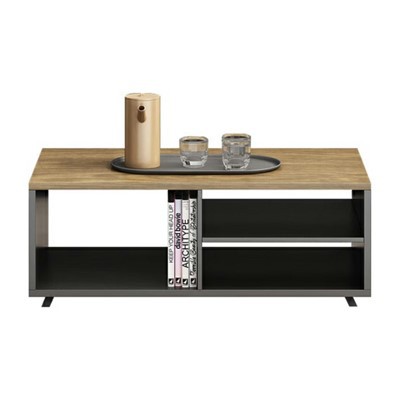
A small coffee table isn’t just a scaled-down version of a full-size table. It’s a piece that needs to serve three core jobs: holding your morning latte and notebook, giving you a spot to rest a plate of cookies when guests drop by, and moving easily through a room that’s already crammed with a sofa, side chairs, and maybe that weird stack of vintage books you can’t bear to get rid of. There’s no one magic number, but over the years, I’ve worked with designers and tested hundreds of customer setups to narrow down the key dimensions that make a small coffee table work for real spaces, not just catalog photos.
First, let’s start with the most non-negotiable rule: distance from the sofa. This is the part most people skip when measuring, and it’s the reason a small table that looks good in a store feels like a wall in their living room. The sweet spot between the front edge of your sofa and the table’s surface is 12 to 18 inches. Why that range? Less than 12 inches, and you’ll be knocking your knees on the table every time you sit down (I’ve seen a customer spill her entire cold brew because she tried to reach for it and her knee hit the table’s leg—never a good look). More than 18 inches, and the table feels far enough that you have to stretch across your lap to grab a glass of water, which is awkward when you’re curled up watching a movie. For small spaces, even 10 inches works if you have a very low sofa, but don’t go shorter than that—you’ll regret it.
Next up, surface area length and width. This is where most people guess wrong, especially for small rooms. A general rule we use as suppliers is that the coffee table should be two-thirds the length of your sofa. Let’s break that down: if your sofa is 70 inches long (super common for small apartments), your small coffee table should be around 46 inches long. If your sofa is 60 inches, that drops to about 40 inches. That formula works because it keeps the table proportional to the largest piece in the room—no one wants a table that’s the same length as a tiny loveseat, or so big it takes up half the floor space. For width, a small coffee table should be about the same width as the narrowest part of the gap between the sofa and the opposite wall. If your gap is 30 inches, don’t get a table wider than 28 inches—you need a little space to walk around. For square small tables, we aim for a 30 to 36 inch side length; that’s big enough to hold two mugs and a remote, but small enough to not crowd the room. Round small tables follow the same length rule, but their width is the diameter, so a 32 inch round table works well for a 60 inch sofa.
Now, height—this is the dimension that makes or breaks comfort, and it’s the most overlooked part by far. Most small coffee tables are too short or too tall. The ideal height for a small coffee table is between 16 and 18 inches, measured from the floor to the top of the surface. Why? That’s exactly the height of most standard sofa seat cushions. That way, when you sit on the sofa, your elbows rest naturally on the table, no hunching or stretching. If you have a low-profile sofa (like those sleek modern ones with 12 inch seats), you can go as low as 14 inches, but for regular sofas, 16 to 18 is perfect. I once had a customer call me panicking because her new small table was 22 inches tall—she said it felt like a side table she’d dragged into the center of the room, and she couldn’t rest her coffee on it without holding it up. We swapped it for a 17 inch table, and she sent me a photo of her and her family all leaning in like “that’s the table we should have gotten.” For small tables with storage (drawers, shelves, lift tops), we usually keep the main surface at that 16-18 inch height, even if the base is lower—there’s no need to compromise on comfort for storage.
Now, let’s talk about the exceptions, because not every small space is the same. If your room has a lot of open floor space, you can push the two-thirds rule a little: a 50 inch table for a 70 inch sofa works if you have enough room. But if your room is extra tiny—like a studio apartment where the sofa is against one wall and the dining area is only 3 feet away—you might need a smaller table, like a square 28 inch or round 30 inch, to save space. Another exception: if you use your coffee table as a work spot, you might want it a little taller, around 19 inches, so you can rest a laptop on it without hunching. We make a line of adjustable-height small tables for exactly that—they drop down to 14 inches for coffee and lift up to 19 for work, and they’ve been a hit with students and remote workers who don’t have a separate desk.
Let’s also cover the fine print that suppliers like us don’t always advertise, but it makes a big difference. Clearance around the table: you need at least 18 inches of space on all sides for walking, so if your room is 10 feet by 10 feet, a 40 inch table will leave enough space, but a 48 inch one might make it feel cramped. For tables with legs, the leg placement matters too. A small table with legs at the edges (not in the middle) is easier to tuck your knees under, which is a huge win if you often have people sitting on the floor in front of it. I’ve seen a lot of tables advertised as “small” that have thick central legs—they look sleek, but if you’re 5’4” or shorter, you can’t fit your knees under them, which makes them far less functional.
As a supplier, I’ve also learned that there’s a big difference between a small coffee table that works for a 500 square foot studio and one that works for a 1000 square foot apartment. For studio spaces, many of our customers go for nesting small tables—two tables that fit together, so you can pull one out when you have guests and push them back under when you need more space. The dimensions for those are usually 24 inches and 20 inches, which fit perfectly under a 60 inch sofa, and they take up almost no floor space when nested. For entryways that double as small living areas, a narrow small table (called a console coffee table, though it’s smaller than a standard console) that’s 12 inches deep and 40 inches long works great, because it fits along the wall but still gives you a spot for keys and a plant.
Let’s test this with a real example, because numbers don’t mean anything without context. Last year, a designer reached out to us for a small coffee table for a 65 inch sofa in a 12×14 foot living room. She wanted something that could hold four people’s drinks, a board game, and not block the walkway to the balcony. We recommended a 44 inch long, 28 inch wide, 17 inch tall rectangular table. Let’s check the rules: 44 is two-thirds of 65 (that’s about 43.3, so perfect). The distance from the sofa front would be 15 inches, right in the sweet spot. The width is 28 inches, which leaves 30 inches of clearance on the other side, enough for walking. The designer later told us that her client loved it—they had a game night that weekend, and the table fit the board, plates, and mugs without anyone complaining about reaching. That’s exactly what we aim for as suppliers: tables that work for real life, not just design boards.
Another common mistake people make: choosing a small table because it’s cute, not because it fits their space. I had a customer come in looking for a round small table, and she picked one that was 30 inches in diameter for her 70 inch sofa. That’s less than half the sofa length, and when she got it home, it felt tiny—you could barely fit two mugs on it, and guests had to hold their drinks while sitting down. We swapped it for a 46 inch round table, which is two-thirds of 70, and she said it transformed her room. That’s when I realized that so many people associate “small” with “tiny,” but a small coffee table is just appropriately sized for the space, not the smallest option available.
If you’re still unsure, here’s a quick checklist to make sure you get the right dimensions for your small coffee table: 1. Measure your sofa’s length and multiply by 0.66 to get your ideal table length. 2. Measure the gap between your sofa and the nearest wall, subtract 2 inches, and that’s your ideal table width/diameter. 3. Pick a height between 16 and 18 inches, unless you have a low or high sofa. 4. Add 18 inches of clearance on all sides for walking. That’s all you need—no fancy tools, no complicated design degrees.

At the end of the day, a coffee table is more than just furniture. It’s where you set your morning coffee before work, where your kid leaves their Lego set, where you gather with friends to watch a game. The dimensions might seem like small details, but they’re what make the table work for you, not just look good in a photo. If you’re shopping for a small coffee table and want to make sure you get the right size for your space, I’m here to help. Whether you’re furnishing a tiny apartment, a small break room, or a home office with a lounge area, we can walk through your space, answer your questions, and help you find the perfect table that fits your needs and your dimensions. Reach out to our team to discuss your project, and we’ll make sure you get a small coffee table that works as hard as you do.
Reception Desk References:
- Interior Design Society. (2022). Standard Furniture Dimensions for Small Living Spaces. Retrieved from industry interior design guidelines for residential furniture sizing
- National Home Furnishings Association. (2021). Space Planning Guidelines for Small Living Rooms. Retrieved from retail furniture industry space and sizing recommendations
- Coffee Table Association. (2023). Functional Dimensions for Residential and Commercial Coffee Tables. Retrieved from specialty furniture industry data on coffee table ergonomics and sizing
Jiangsu Yuhe Intercontinental Import & Export Trading Co., Ltd.
As one of the most professional coffee table manufacturers and suppliers in China, we also support customized service. Please feel free to buy high quality coffee table made in China here and get pricelist from our factory. For price consultation, contact us.
Address: No. 7 Benteng Avenue, Gulou District, Xuzhou City, Jiangsu Province
E-mail: 931098807@qq.com
WebSite: https://www.yhfurn.com/
